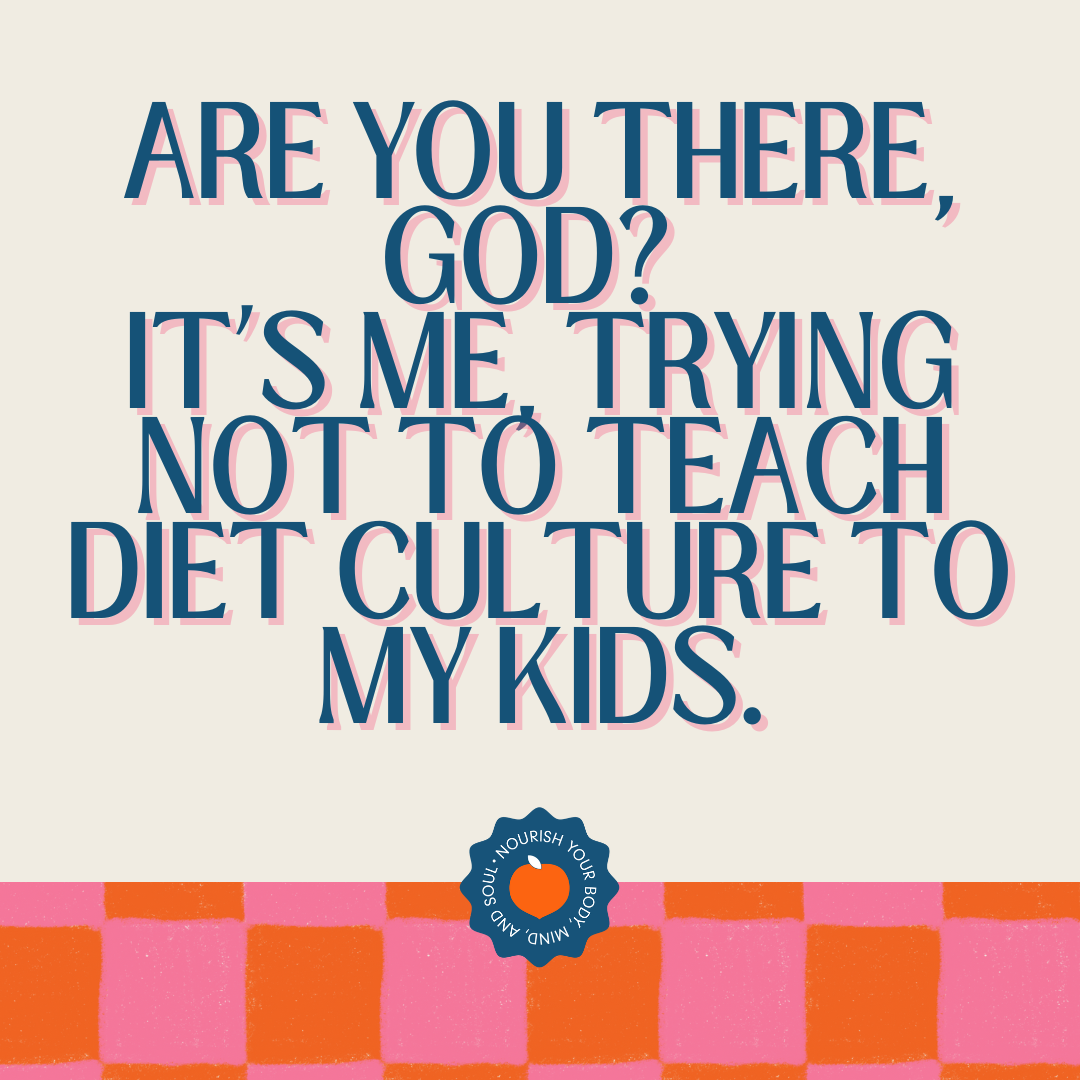
Remember Judy Blume’s classic, “Are You There God? It’s Me, Margaret?” Well, I’m feeling a little like Margaret again, except now my worries are about protecting my kids from diet culture.
Most of us grew up in a world where commenting on bodies was completely normal. People talked about weight like it was small talk. Someone would lose weight and everyone would celebrate. Someone would gain weight and suddenly people got “concerned.” People joked about needing to “be good” after eating dessert or said they had to “work off” what they ate.
It was everywhere.
But the truth is, the way we talk about bodies and food isn’t harmless background noise. It shapes what we believe about ourselves. It shapes what we think health looks like. And for kids especially, those messages can become deeply ingrained long before they even have the words to explain what they’re feeling.
Body Talk Isn’t Neutral
A lot of body-related comments are said casually, without much thought:
- “Ugh, I feel disgusting.”
- “I shouldn’t eat this.”
- “I need to lose weight.”
- “I’m being so bad today.”
- “I hate how I look.”
People usually don’t mean anything by it. They’re just venting. But those comments still land.
They teach that bodies are meant to be evaluated. That eating comes with guilt. That being smaller is always better. That weight gain is something to panic about. That hunger can’t always be trusted.
And kids are paying attention.
Even if no one is talking about their body directly, they’re absorbing the message that bodies are something to fix.
Shame Doesn’t Make People Healthier
Diet culture loves to sell the idea that body dissatisfaction is motivating. That if people feel bad enough, they’ll finally “get it together.” But that’s not how humans work.
When people feel judged (by others or by themselves), it tends to create more stress, not better health. And stress affects everything: sleep, digestion, hormones, appetite, cravings, mood, energy. On top of that, shame makes people less likely to seek medical care, more likely to hide their eating, and more likely to fall into cycles of restriction and overeating. None of this is a willpower issue. It’s a predictable response to pressure and deprivation.
If we actually want long-term health habits, fear is a terrible foundation.
Food Isn’t “Good” or “Bad”
One of the most exhausting things diet culture has normalized is the idea that food has moral value.
Salad = good.
Cookies = bad.
Carbs = “dangerous.”
Dessert = something you have to earn.
Even when it’s said jokingly, it trains people to feel guilt for eating normal foods. It turns eating into something you can succeed or fail at. And over time, that creates anxiety, rigidity, and a lot of unnecessary mental noise. Food is not a test. It’s not a measure of discipline. It’s not something you need to apologize for.
A Better Way to Think About Health
Being weight-inclusive doesn’t mean we ignore nutrition or pretend health doesn’t matter. It means we focus on things that actually support wellbeing without turning the scale into the main indicator of success.
Real health support might look like:
- eating consistently throughout the day
- having meals that include carbs, protein, and fat
- getting enough food (especially earlier in the day)
- improving sleep
- managing stress
- building strength
- finding movement that feels supportive and enjoyable, not punishing
- learning to eat in a way that feels flexible and sustainable
None of that requires shame. None of that requires perfection. And none of it depends on having a certain body type.
What to Say Instead (That Doesn’t Feel Fake)
A lot of people worry that avoiding body criticism means forcing “body positivity.” That’s not what we’re going for. You don’t have to love your body every day. You don’t have to pretend you feel confident all the time. You can be honest without being cruel.
Here are a few language shifts that can help:
Instead of: “I feel so fat.”
Try: “I’m feeling uncomfortable in my body today.”
Instead of: “I was bad this weekend.”
Try: “I ate differently than usual. I’m going to check in with what I need today.”
Instead of: “I can’t have that.”
Try: “I can have it, I’m just deciding what I want right now.”
Instead of: “I need to burn this off.”
Try: “Movement helps me feel better in my body.”
Small changes like this might seem insignificant, but they create a totally different environment around food and bodies, especially for kids.
Parents: You Don’t Need to Be Perfect
If you’re raising kids, you’ve probably had moments where you catch yourself saying something about your body and immediately think, Oh no. But kids don’t need perfect parents. They need parents who are aware. If you slip up, you can repair it out loud. That matters more than never messing up.
You can say:
“I just said something unkind about my body. I’m trying to practice speaking about myself with more respect.”
That one sentence teaches kids something huge: that bodies deserve respect, and that self-talk is something we can change.
What We Say Becomes the Culture at Home
Kids are going to hear body and diet messaging out in the world. We can’t control that. But we can make home a place where bodies aren’t constantly evaluated, where food isn’t tied to guilt, and where eating doesn’t come with shame.
That kind of environment doesn’t happen by accident. It happens through small, consistent choices: what we praise, what we criticize, what we joke about, and what we treat as normal. Because at the end of the day, you can’t hate yourself healthy.
Noticing your child (or yourself) struggling with body image, food anxiety, or diet culture pressures? You don’t have to handle it alone. At Peachy Nutrition, we support both parents and kids with practical, compassionate guidance to build body-positive homes and healthy relationships with food. Schedule a session today and let’s keep the conversation going! You aren’t alone.
hello@peachy-nutrition.com
704-266-0864
Resources:
- Fat Talk: Parenting in the Age of Diet Culture
- Body Respect: What Conventional Health Books Get Wrong, Leave Out, and Just Plain Fail to Understand about Weight – Linda Bacon & Lucy Aphramor
- Anti-Diet: Reclaim Your Time, Money, Well-Being, and Happiness Through Intuitive Eating – Christy Harrison
- NEDA website
- Project HEAL
- F.E.A.S.T
- The Alliance for Eating Disorders
- Peachy Nutrition
By Alex Hussey Lipa, MS, RD/LDN, CEDS-C